Agentic Commerce Is Here: Is Your Ecommerce Store Ready for AI Buyers?
- Daniel Pisano

- Jun 22
- 3 min read
or more than two decades, ecommerce has been designed for people.
Retailers invested heavily in website design, mobile experiences, conversion rate optimization, search engine optimization, and digital marketing strategies focused on attracting and converting human shoppers.
But a new type of buyer is emerging.
Not a consumer browsing your website.
Not someone comparing products manually.
Instead, an AI-powered agent capable of researching products, comparing alternatives, evaluating reviews, and even completing purchases on behalf of consumers.
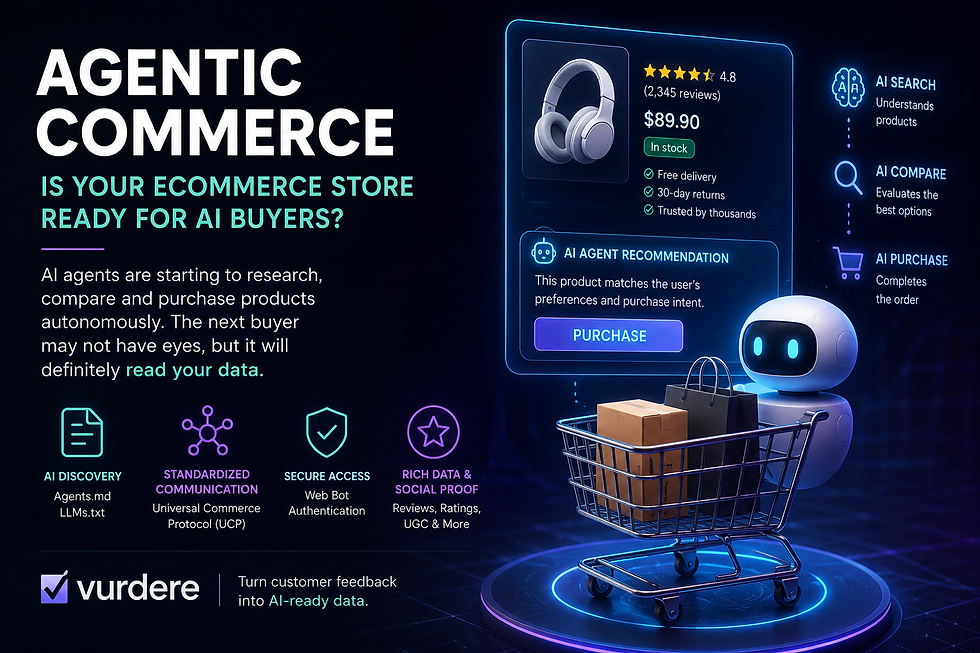
This shift is commonly referred to as Agentic Commerce, and recent developments from Shopify suggest that the transition has already begun.
Why Shopify's Recent Updates Matter
Between April and May 2026, Shopify introduced several infrastructure-level updates that may prove more important than any new storefront feature.
Among them are:
Automatic generation of agents.md
Automatic generation of llms.txt
Universal Commerce Protocol (UCP)
Web Bot Authentication
These technologies create a foundation that allows AI agents to discover stores, access product information, compare alternatives, evaluate product quality, and eventually make purchasing decisions.
Rather than optimizing stores exclusively for humans, ecommerce platforms are beginning to optimize stores for machines.
This is not simply a Shopify story.
It is an early signal of where ecommerce is heading.
From SEO to AEO
For years, ecommerce success depended heavily on Search Engine Optimization (SEO).
The goal was visibility.
Brands competed for rankings, impressions, clicks, and traffic.
Agentic Commerce introduces a new challenge.
Being found is no longer enough.
Products must also be selected by AI systems.
This emerging discipline is often called Agent Experience Optimization (AEO).
Instead of asking:
"Can customers find my product?"
Retailers must begin asking:
"Can AI agents understand, evaluate, and recommend my product?"
This seemingly small difference changes everything.
Why Product Reviews Become Critical
When consumers shop online, reviews help build confidence.
When AI agents shop, reviews become evidence.
An AI system evaluating multiple products may analyze:
Review ratings
Review volume
Verified purchase status
Product attributes
Customer-generated photos
Customer-generated videos
Questions and answers
Consumer sentiment
A review that simply says:
"Great product."
provides limited value.
A review explaining how the product was used, who used it, and why it performed well creates significantly richer signals.
The more context available, the easier it becomes for AI systems to recommend products accurately.
The Rise of Structured Social Proof
Many retailers assume that AI-driven commerce will become a race to the lowest price.
The reality is likely to be far more sophisticated.
AI agents can simultaneously evaluate:
Price
Availability
Delivery speed
Product quality
Consumer satisfaction
Reputation
Brand trust
Real customer experiences
This is where structured social proof becomes increasingly valuable.
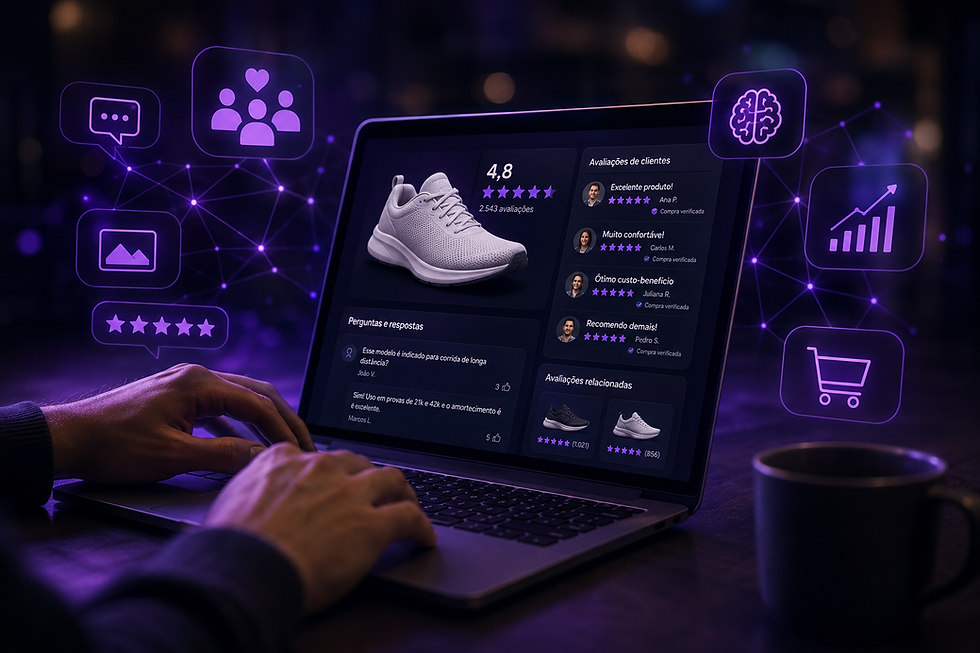
Verified reviews, user-generated content, customer photos, videos, and behavioral insights create a layer of information that benefits both consumers and AI systems.
How Retailers Can Prepare Today
The good news is that most retailers do not need a complete technology overhaul.
Many already possess the foundation required to compete in an Agentic Commerce environment.
Start by focusing on:
1. Review Collection
Increase the volume of verified customer reviews.
2. Rich User-Generated Content
Encourage customers to submit photos and videos.
3. Product Attributes
Ensure products contain structured specifications and attributes.
4. Structured Data
Implement schema markup wherever possible.
5. AI Discovery Files
Review and optimize files such as llms.txt and agents.md.
6. Product Knowledge
Create richer product information that helps both humans and AI understand usage scenarios.
The Next Buyer May Never Visit Your Website
Agentic Commerce does not mean ecommerce websites will disappear.
It means that more purchase decisions may be influenced by systems that evaluate information differently than people do.
In this environment, structured data, verified reviews, reputation signals, and accessible product information become part of the infrastructure that determines visibility and competitiveness.
The next buyer may never visit your homepage.
They may never browse your categories.
They may never manually compare products.
But their AI agent certainly will.
The question is whether your products provide enough information to be selected.
Frequently Asked Questions
What is Agentic Commerce?
Agentic Commerce refers to ecommerce experiences where AI agents research, compare, recommend, and potentially purchase products on behalf of consumers.
What is AEO?
Agent Experience Optimization (AEO) is the practice of optimizing product information and content so AI agents can understand and recommend products more effectively.
Why are reviews important for AI shopping?
Reviews provide contextual information that helps AI systems evaluate product quality, customer satisfaction, and suitability for specific use cases.
Is Agentic Commerce replacing traditional ecommerce?
No. It is expanding ecommerce by introducing AI agents as an additional layer between consumers and online stores.


Comments